
There is something happening in security that I think we need to talk about differently.
We spend a lot of time talking about theft, fraud, organized retail crime, cargo theft and the challenges facing our supply chains. We talk about cameras, analytics, access control, monitoring and artificial intelligence. We talk about losses and statistics and the latest technology designed to prevent them.
All of that matters.
But after spending years working alongside the people who are actually responsible for protecting these environments, I think there is another part of the conversation that sometimes gets lost.
These aren’t just security problems.
They’re people’s problems.
There is a security manager trying to protect hundreds of employees across multiple facilities. There is a loss prevention professional trying to understand why the same type of incident keeps happening in different locations. There is a transportation manager trying to keep cargo moving while dealing with increasingly sophisticated attempts to manipulate the supply chain. There is a facilities team being asked to secure a property that wasn’t designed for today’s threat environment.
And increasingly, these people aren’t dealing with isolated acts of theft.
They’re dealing with organized, strategic activity.
That distinction matters.
The Threat Has Become More Strategic
The traditional picture of crime is relatively simple. Someone sees an opportunity, takes advantage of it and leaves.
That still happens every day.
But some of the activity we’re seeing across retail, distribution and transportation is much more deliberate. Criminal organizations are studying processes, identifying weaknesses and figuring out how to exploit the space between systems, people and procedures.
The FBI now specifically distinguishes “strategic cargo theft” from straightforward physical theft. In these cases, deceptive tactics can be used to facilitate the physical theft, including impersonating legitimate businesses, manipulating transactions or compromising accounts.
And this isn’t simply a theoretical shift.
In April 2026, the FBI warned that cyber-enabled strategic cargo theft was surging. According to the FBI, estimated cargo theft losses in the United States and Canada reached nearly $725 million in 2025, a 60% increase from 2024. Confirmed cargo theft incidents increased 18%, while the average value per theft rose 36% to $273,990. The FBI attributed the increase in average value to criminals becoming more selective about high-value targets.
Think about what that tells us. The criminal doesn’t necessarily have to break into the warehouse. They may be able to manipulate the process that gets the shipment out of the warehouse. A fraudulent pickup can become a cargo theft. A compromised credential can become unauthorized access.
Information gathered at one location can be used to target another. A stolen shipment can move through a network of legitimate businesses before anyone realizes something is wrong.
What concerns me isn’t simply that these crimes are becoming more sophisticated. It’s that the people on the other side of the equation are often being asked to respond with systems that were designed for a different era.
A camera gets installed. An alarm gets triggered. Someone reviews the footage after the fact. A report gets written. And then everyone moves on to the next incident.
That isn’t necessarily security. It’s essentially just documentation.
Organized Crime Doesn’t Respect Organizational Boundaries
One of the biggest mistakes we can make is thinking about organized crime as a collection of isolated incidents.
Take organized retail crime.
The theft that happens inside a retail location may be only one small piece of a much larger operation. Merchandise can move through warehouses, transportation networks, storage locations and online marketplaces before it is ultimately converted back into cash.
And we’re seeing evidence that the methods are evolving.
The National Retail Federation’s 2026 research found that retailers reported increases in several types of fraud and organized criminal activity. Among the retailers surveyed, 69% reported an increase in phone scams, 51% reported an increase in loyalty fraud and 42% reported an increase in gift-card theft or fraud. Retailers also reported increases in repeat offenders and organized retail crime-related incidents.
At the same time, traditional shoplifting incidents actually declined.
NRF’s 2026 study found that retailers experienced an average 12.4% decrease in shoplifting incidents and an 8.1% decline in retail merchandise theft in 2025 compared with 2024.
That is an interesting distinction. It doesn’t mean retail security problems are going away. It suggests the problem is changing. Criminal activity doesn’t disappear because one pathway becomes harder.
It looks for another pathway. That same principle applies to cargo, transportation and distribution. The criminal activity doesn’t necessarily begin where the loss occurs.
It may begin with information. It may begin with a compromised process. It may begin with someone learning how a facility operates.
By the time the physical theft takes place, the criminal organization may already understand the schedule, the people, the equipment and the vulnerabilities involved. That’s why I believe the security conversation needs to expand.
We can’t simply ask, “How do we stop someone from getting through the fence?”
We also have to ask: What happened before they got to the fence?
Sometimes Fewer Crimes Doesn’t Mean Less Risk
There is another statistic from the transportation side that really caught my attention.
Verisk CargoNet documented 677 supply-chain theft incidents in the second quarter of 2026, a 26% decline from the same quarter a year earlier.
That sounds encouraging.
But estimated losses reached $304.6 million, more than double the $135.7 million estimated in Q2 2025. CargoNet also reported that compromise-based schemes, including business email fraud and shipment misdirection, continued even as some forms of physical theft declined.
In other words, fewer incidents did not necessarily mean less risk.
The people committing these crimes may simply be getting more selective.
They’re looking for the right shipment. The right commodity. The right vulnerability. The right opportunity.
CargoNet’s Q2 analysis specifically noted that organized groups were increasingly focused on high-value commodities and that business email compromise remained a primary access point for sophisticated cargo theft schemes.
That is exactly why security professionals need visibility into more than the individual incident.
The Question I Hear More Often
One of the questions I hear more frequently from security professionals is some variation of:
“How do we get ahead of this?” Not, “How do we get better video?” Not, “How do we buy another camera?”
How do we get ahead of it? That’s a very different question.
It requires us to think about security as something dynamic. If a distribution yard suddenly becomes a problem, we shouldn’t necessarily have to wait months for a permanent security project. If a retail location develops a pattern of organized activity, we should be able to put additional eyes on that location quickly. If a transportation facility experiences a series of suspicious events, we should be able to increase visibility while the underlying issue is being investigated.
If a piece of critical infrastructure suddenly becomes more vulnerable, the response can’t always be, “We’ll get that into next year’s capital budget.”
The threat doesn’t work on a capital budget cycle.
So, why should security?
Rapid Deployment Changes the Conversation
One of the things I find most compelling about where security technology is headed is the ability to deploy meaningful protection quickly.
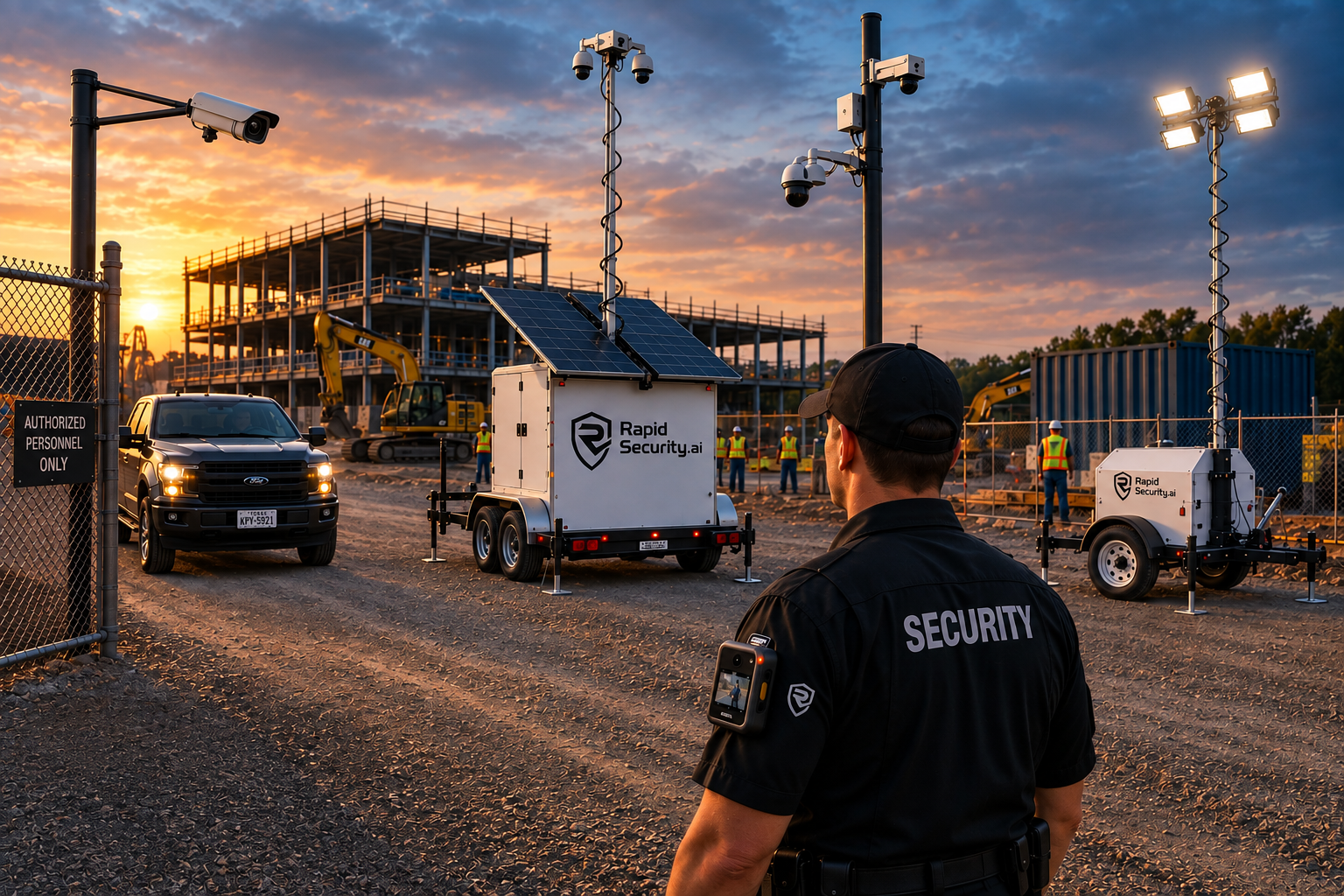
A mobile surveillance unit can put cameras, communications, lighting and monitoring capability into a location without requiring months of construction.
A wall-mounted camera can provide focused coverage exactly where a vulnerability exists.
A body-worn camera can give personnel an entirely different level of visibility and accountability when they’re interacting with people in the field.
And 24/7 monitoring can put an actual person behind all of that technology.
That last part is important.
Because I don’t think the future of security is simply more automation. I think it is better technology combined with better human involvement. Technology should help people see more, understand more and respond faster.
It shouldn’t simply create another screen for someone to watch.
The Camera Is Not the Point
I’ve always believed that the camera is one of the least interesting parts of a security conversation. What the camera allows you to understand is much more important. Imagine a mobile surveillance unit deployed to a location experiencing repeated after-hours activity.
The objective isn’t simply to capture the next incident. It’s to understand the environment.
What time does the activity occur? Are the same vehicles appearing? Are people approaching from the same direction? Does activity increase after a particular operational event? Is there a connection between what’s happening at this facility and something happening somewhere else?
Now the security team isn’t simply looking at video. They’re gathering intelligence.
That is a fundamentally different use of technology.
And when those observations can be combined across locations, monitored in real time and acted upon quickly, security starts becoming proactive rather than purely reactive.
The Integrator’s Role Is Changing
This is where I believe the integrator has an opportunity to become much more than the company that installs the equipment.
We have a unique vantage point. We get to see what happens in the field. We see the environments. We talk to the security teams.
We see what works and what doesn’t. And, if we’re doing our job correctly, we listen before we recommend anything.
Because the person responsible for security at a large distribution center doesn’t need another salesperson telling them that AI is going to solve everything.
They need someone who understands that they have hundreds of employees, hundreds of trailers, multiple shifts, a limited budget and an executive team asking why losses increased this quarter.
The loss prevention director doesn’t need a 40-page technology presentation. They need someone to understand why the same type of incident keeps appearing across multiple stores.
The transportation security manager doesn’t need another vendor telling them that their cameras are obsolete. They need someone willing to sit down and understand how their operation actually works.
That is where empathy matters in security. Not as a soft concept. As a practical one.
You cannot design an effective security strategy for an environment you don’t understand.
Deterrence Still Matters
There is also something wonderfully simple about visible security. People notice it.
A visible mobile surveillance unit changes the perception of a property. A well-placed camera changes the equation. Lighting changes the environment. A monitored location communicates that someone is paying attention.
None of these things guarantees that crime won’t occur. But organized criminal activity is ultimately about risk and opportunity. Making an environment more visible, more monitored and more difficult to exploit can change the calculation.
Sometimes the best incident is the one that never happens.
That part of security doesn’t always show up in a report.
But the people responsible for protecting these environments understand its value.
Real-Time Service Is Where Technology Becomes Security
This is also why I believe the service component of security is becoming increasingly important.
We can deploy incredible technology today.
But if nobody is paying attention when something happens, what have we really accomplished?
A system can generate an alert. A camera can identify movement. An analytic can recognize a person or vehicle. But someone still needs to determine whether that activity matters. Someone needs to understand the customer’s environment.
Someone needs to know when an unusual event is actually unusual. And someone needs to be willing to pick up the phone and say:
“We’re seeing something you need to know about.”
That is the difference between technology and security. It is also where the integrator can provide real value. The best relationships I’ve seen in this industry aren’t transactional. They’re collaborative.
The security team knows they can call. The integrator knows the environment. The monitoring team understands the expectations. And when something changes, everyone moves. That’s what I mean by white-glove service.
Not a buzzword. Not a concierge label.
Just being there when the customer actually needs you.
Security Should Create Intelligence, Not Just Evidence
There is an important distinction between collecting evidence and creating intelligence.
Evidence tells us what happened. Intelligence helps us understand what may be happening.
That distinction becomes particularly important when dealing with organized criminal activity. If a mobile surveillance unit captures the same vehicle at three different facilities, that may be more meaningful than any individual event.
If a wall-mounted camera shows a recurring pattern around a loading dock, that may tell us something about a vulnerability in the operation.
If body-worn camera footage identifies recurring behavior involving people interacting with employees or property, that information may become part of a much larger picture.
None of these observations necessarily proves that there is an organized operation. But together, they can give security professionals something they didn’t have before: context.
And context is often what allows people to move from reacting to incidents to addressing the conditions that make those incidents possible.
We Don’t Need to Predict Every Crime
I don’t think our job as an industry is to pretend we can predict every criminal act. We can’t. What we can do is make it harder to operate unnoticed.
We can create more visibility. We can connect information. We can deploy protection quickly when circumstances change. We can put people behind the technology who know what they’re looking at. We can help security professionals identify patterns that might otherwise remain disconnected.
And we can give them the flexibility to change their security posture as the threat changes.
That is a much more realistic definition of proactive security.
The Future Is Faster, More Flexible and More Human
The security industry is moving toward more intelligence, more automation and more connected systems. I believe all of that will be important.
But I also believe we need to be careful not to lose the human element in the process. Because behind every security incident is a person who has to deal with it. Behind every stolen shipment is a business that has to absorb the loss. Behind every compromised facility is a security professional who has to explain what happened. And behind every successful intervention is usually a person who noticed something, asked the right question and acted.
Technology can make that person dramatically more effective. That’s where I believe the future of physical security is headed.
Not simply toward more cameras. Not simply toward more artificial intelligence.
Not simply toward more monitoring. But toward security that can move when the threat moves.
Rapidly deployed technology. Real-time visibility. 24/7 human response.
Better intelligence.
And an integrator who understands that the ultimate objective isn’t selling another security system. It’s helping the people responsible for protecting our businesses, our supply chains, our employees and our critical infrastructure do their jobs better.
If we can make it harder for organized criminal activity to operate unnoticed, if we can identify patterns earlier, if we can deter activity before it becomes an incident and if we can respond faster when something does happen, then we’re doing more than installing security technology.
We’re helping reduce the opportunity for crime.
And ultimately, that’s what security should be about.