
When a security problem shows up, nobody wants to hear that the solution will be ready in six months.
They need something now.
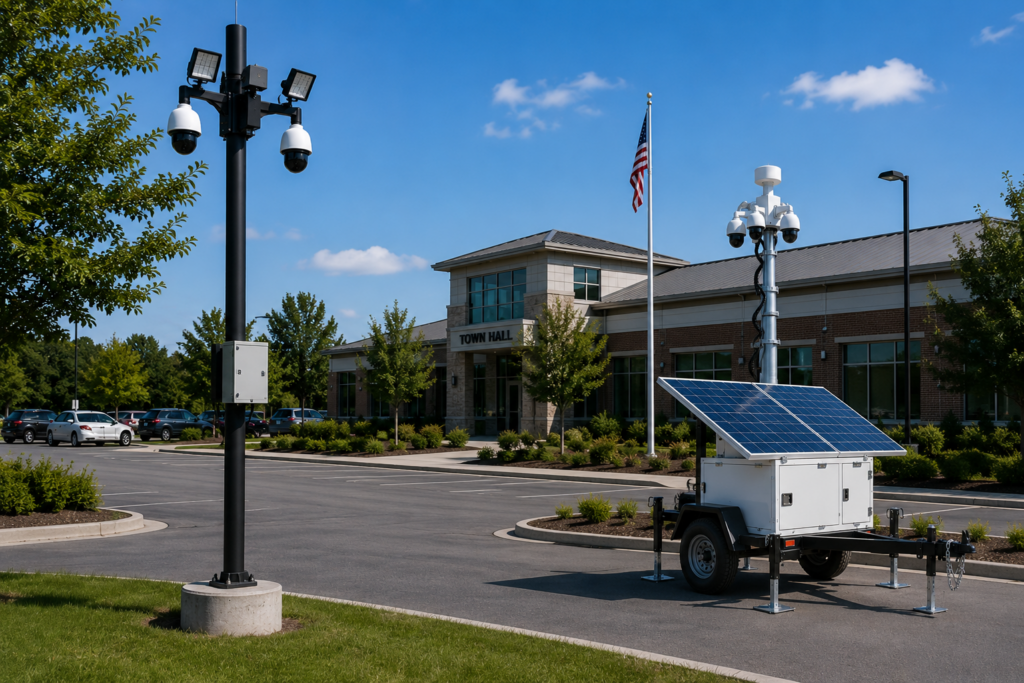
That is why rapid deployment has become such an important part of modern physical security. Whether it is a mobile surveillance unit, a wall or pole-mounted camera, body-worn technology, remote monitoring, or a combination of all of the above, the ability to get protection in place quickly can make a meaningful difference.
Because when you are trying to prevent crime, time matters.
The Gap Between Knowing You Have a Problem and Solving It
Think about a construction site that has experienced repeated theft. A parking lot where vehicles are being broken into. A vacant property that has become a target for trespassing. A retail location dealing with organized theft.
The problem is already happening.
Traditional security projects can involve engineering, permitting, trenching, electrical work, network infrastructure, construction and weeks or months of coordination before a camera ever becomes operational.
Meanwhile, the property remains exposed.
Rapid deployment changes that equation.
A mobile surveillance unit can arrive on site and provide cameras, lighting, communications, speakers and remote monitoring without waiting for permanent infrastructure to be built. A pole-mounted or wall-mounted solution can provide targeted coverage where it is needed. Body cameras can give frontline teams an additional layer of accountability and situational awareness. Remote monitoring can turn video from something you look at after an incident into something that can help respond while an incident is happening.
That is a pretty significant difference.
Visibility Matters
There is a misconception that security technology is primarily about catching criminals after the fact.
It can be. But the bigger opportunity is preventing the incident from happening in the first place.
Research supports that idea.
A 40-year systematic review and meta-analysis of CCTV found that surveillance was associated with a significant, although modest, reduction in crime. The research also found that actively monitored systems produced larger effects than passive systems, and that combining surveillance with other interventions was more effective than relying on cameras alone.
More recent research published in the Journal of Development Economics found that cities with denser surveillance networks experienced significantly steeper declines in crime, with particularly strong effects on publicly visible crimes such as theft, robbery and other offenses.
The takeaway is not that putting up a camera magically eliminates crime.
It is that visible, intelligent and actively managed security can change the equation.
And speed makes that equation even more powerful.
Rapid Deployment + Great Technology = Real Deterrence
The best rapid-deployment solutions are not simply cameras sitting on a trailer.
They combine technology into a security ecosystem.
High-resolution cameras. Artificial intelligence and analytics. Two-way audio. Lighting. Environmental sensors. Cellular or private network connectivity. Body-worn cameras. Remote video monitoring. Automated alerts.
Each technology can provide value on its own.
Together, they can create a much stronger layer of protection.
Imagine a camera detecting someone entering a restricted area after hours. An analytics platform identifies the activity. A monitoring professional receives the alert, verifies the event and uses two-way audio to communicate with the individual. The situation can then be escalated to the appropriate response team if necessary.
That is very different from simply recording an event and reviewing the footage the next morning.
Speed Creates Flexibility
Another major advantage of rapid deployment is that security needs are rarely permanent.
Construction sites move.
Events come and go.
Crime patterns change.
Vacant properties get occupied.
Businesses expand.
Infrastructure projects create temporary vulnerabilities.
A security solution that can be deployed quickly can also be moved quickly.
That flexibility is incredibly valuable.
Instead of asking, “Where should we permanently install cameras?”
Security teams can start asking a better question:
“Where do we need security right now?”
That shift is important.
The Numbers Tell Part of the Story
According to the Bureau of Justice Statistics, the U.S. property crime rate declined 9% in 2024, from 2,019.7 offenses per 100,000 people to 1,835.1.
That is encouraging.
But lower crime rates do not mean the problem has disappeared. The FBI’s 2024 data still accounted for more than 14 million reported criminal offenses across participating agencies.
Organizations still have to protect people, property, equipment and operations.
And they increasingly have to do it in environments where traditional security infrastructure is expensive, slow to install or simply not practical.
That is where rapid deployment becomes more than a convenience.
It becomes a strategy.
Security Should Move at the Speed of the Threat
The physical security industry has spent decades building permanent infrastructure.
There is still a place for it.
But today’s threats are dynamic. Security technology should be dynamic too.
The ability to put a highly capable security solution exactly where it is needed, when it is needed, creates an entirely different approach to protecting people and property.
Mobile surveillance units.
Wall and pole-mounted cameras.
Body-worn cameras.
Remote monitoring.
AI-powered analytics.
Connected communications.
These technologies are powerful individually. But when they are combined with rapid deployment, they become something much bigger.
They create presence.
They create visibility.
They create response.
And perhaps most importantly, they create uncertainty for someone who is thinking about committing a crime.
Because the best security outcome is not always the arrest.
Sometimes it is the crime that never happens.
Deploy fast. See more. Respond faster. Deter what you can.
That is where the future of physical security is headed. We’re excited to talk to you about it.